

Description
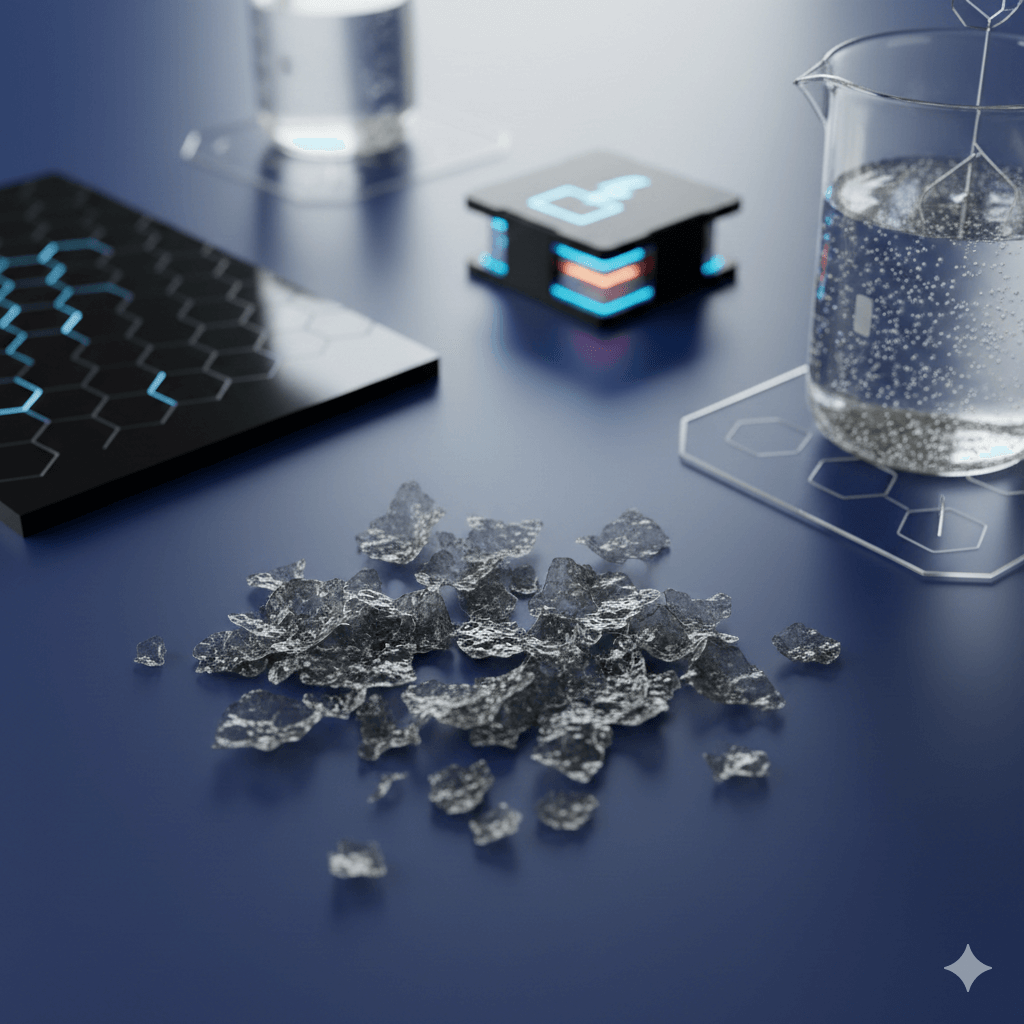
Graphene Nanoflakes (GNFs) are ultra-thin, micron- to nano-sized platelets derived from high-quality graphene sheets. Engineered for superior electronic, mechanical, and thermal performance, GNFs combine the advantages of pristine graphene with a process-friendly flake morphology, making them highly versatile for industrial, scientific, and advanced technological applications.
Structure & Composition
Graphene nanoflakes consist of:
- Few-layer graphene sheets (typically 1–10 layers)
- Lateral dimensions ranging from 20 nm to several micrometres
- High edge density, enabling accelerated surface reactions
- Purity levels up to 99% carbon, depending on grade
This unique combination of large surface area, atomic thickness, and abundant edge sites makes GNFs exceptionally active and dispersible.
Key Features & Properties
- Ultra-high surface area (500–900 m²/g)
- Excellent electrical conductivity
- Superior mechanical stiffness and flexibility
- Thermal stability > 600°C in inert conditions
- Active edge sites for enhanced functionalization
- Easy integration in polymer, metal, and ceramic matrices
- Stable dispersion in water and organic solvents (functionalized grades available)
Advantages of Graphene Nanoflakes
- Enhanced electron transport pathways for batteries and supercapacitors
- Improved mechanical reinforcement in composites
- High catalytic activity due to exposed graphene edges
- Boosted thermal and electrical performance in coatings and adhesives
Applications
Graphene nanoflakes are widely used across advanced materials, electronics, and energy sectors:
Energy & Electronics
- Electrode additive for Li-ion, Na-ion, K-ion, and dual-ion batteries
- High-performance supercapacitor electrodes
- Transparent conductive films, EMI shielding, conductive inks
Composite Reinforcement
- Polymer, epoxy, and resin enhancement
- Strengthening of rubber, plastics, and ceramics
- Aerospace and automotive lightweighting
Coatings & Surface Engineering
- Antistatic and conductive coatings
- Heat-dissipation and corrosion-resistant coatings
- Barrier films and protective layers
Catalysis & Environmental Applications
- Catalyst support for metal nanoparticles
- Photocatalytic and electrocatalytic systems
- Water purification and pollutant adsorption
Sensors & Biomedical Applications
- Electrochemical sensing platforms
- Biosensor functional interfaces
Technical Specifications
| Parameter | Value (Approx.) |
| Carbon Purity | 98–99% |
| Thickness | 1–10 graphene layers |
| Lateral Size | 20 nm – 5 µm (grade-dependent) |
| Surface Area | 500–900 m²/g |
| Electrical Conductivity | Up to 10⁶ S/m |
| Ash Content | < 1% |
| Appearance | Black/grey ultrafine powder |
Custom sizes, surface functionalization (–OH, –COOH, –NH₂), and dispersions available upon request.
Why Choose Our Graphene Nanoflakes?
- Produced through controlled top-down exfoliation ensuring consistency
- High purity with minimal defects
- Batch-to-batch reproducibility
- Compatible with industrial-scale processing
- Available in powder, paste, dispersion, and composite-ready formats



Reviews
There are no reviews yet.