Research & Development
At Altravia Global Private Limited, Research and Development forms the foundation of our commitment to excellence in Bharat Graphene and metal nanoparticle synthesis. Our R&D division combines scientific expertise, advanced instrumentation, and rigorous quality protocols to deliver materials that meet the highest global standards for performance, purity, and reliability.
Impressive Technical Expertise
Our R&D team is composed of highly skilled scientists and engineers specializing in nanomaterials, chemical synthesis, surface engineering, and advanced characterization. With strong command over cutting-edge synthesis techniques—ranging from wet-chemical exfoliation to controlled nucleation methods—we ensure precision at every step of material development.

Clean, Controlled, and Safe Environment
We maintain a clean, contamination-free, and controlled manufacturing environment to ensure unmatched reproducibility and consistency. Class-controlled workspaces, dedicated fume hood systems, and stringent safety measures allow us to uphold the integrity of each R&D process. Every experiment is executed under carefully monitored conditions to preserve the delicate structure and functionality of nanomaterials.
Trustworthy Purity in Nano synthesis
Purity is the hallmark of our technology. Our Bharat Graphene and metal nanoparticles undergo multi-stage purification and quality assurance tests, ensuring:
- Controlled particle size and distribution
- High crystallinity
- Minimal impurities
- Stable surface chemistry
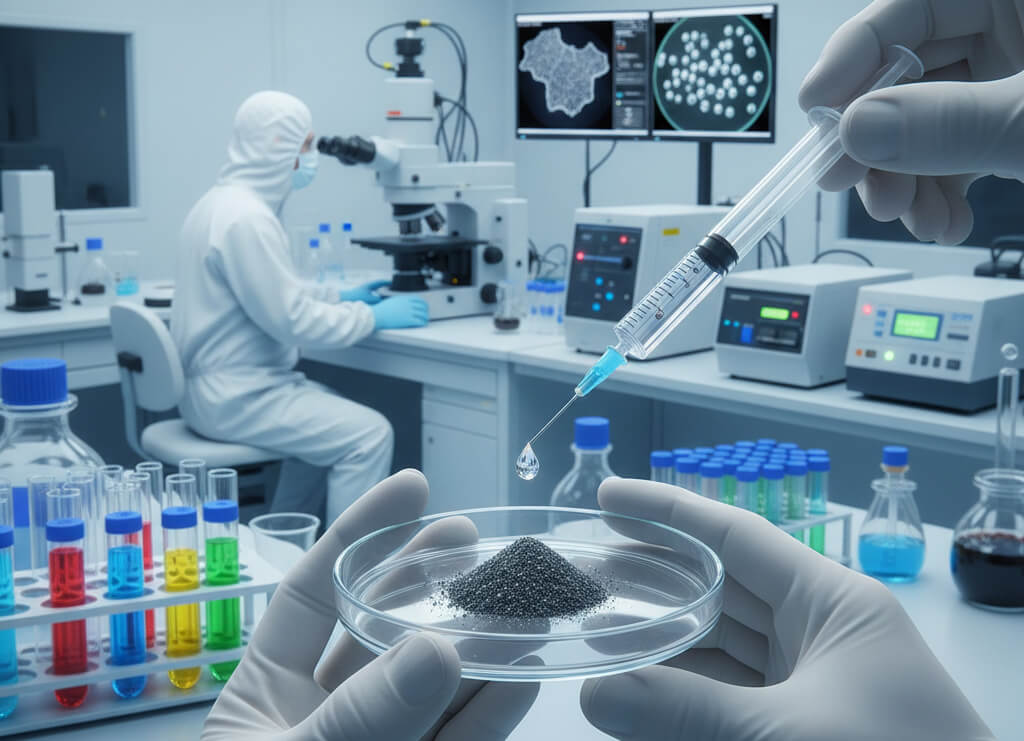
This commitment to purity enables us to meet the demanding requirements of industries such as electronics, clean energy, sensors, catalysis, composites, biomedical devices, and environmental remediation.
High-Grade Chemicals and Inputs
To guarantee superior material performance, we rely exclusively on high-grade precursors, reagents, and solvents sourced from trusted suppliers. Each input material passes a strict quality check before entering the synthesis pipeline. Our insistence on premium chemical standards ensures that every batch of Bharat Graphene and nanoparticles is engineered for top-tier applications.
Driving Innovation for a Sustainable Future
Aligned with India’s vision for technological innovation, our R&D efforts focus on developing advanced materials that support clean energy solutions, sustainable manufacturing, and next-generation industrial technologies. From enhancing energy storage systems to enabling efficient catalysis and environmental cleanup, our research empowers industries with transformative capabilities.
High-Tech Instrumentation for Advanced Nanomaterial Analysis
At Altravia Global Private Limited, precision, and scientific integrity lie at the heart of our material development process. To ensure that Bharat Graphene and our range of metal nanoparticles meet the highest industry and research standards, we rely on a suite of state-of-the-art analytical instruments. These high-tech tools enable us to validate structural properties, purity, morphology, particle size, and elemental composition with unmatched accuracy.
Powder X-Ray Diffraction (XRD)
Powder XRD plays a crucial role in determining the crystal structure, phase purity, interlayer spacing, and graphitic ordering of Bharat Graphene. For metal nanoparticles, XRD provides insight into crystalline phases, grain size (via Scherrer equation), lattice strain, and detection of any undesired impurities. This ensures that every batch meets strict crystallographic benchmarks.
Particle Size Analysis
Advanced size-measurement techniques—including Dynamic Light Scattering (DLS) and laser diffraction—offer precise evaluation of particle size distribution.
- For graphene: lateral dimensions and thickness uniformity are assessed.
- For nanoparticles: monodispersity, hydrodynamic radius, and aggregation behavior are tracked.
These measurements guarantee consistency across applications in electronics, catalysis, energy storage, and coatings.
Scanning Electron Microscopy (SEM)
SEM provides high-resolution imaging to reveal the surface morphology, layer structure, flake orientation, and microstructural integrity of Bharat Graphene.
For metal nanoparticles, SEM helps visualize particle shape, distribution, and any surface irregularities. Our SEM systems offer nanometer-scale clarity, essential for R&D and quality assurance.
Energy-Dispersive X-Ray Spectroscopy (EDS / EDX)
Coupled with SEM, EDS enables rapid and accurate elemental analysis.
- For graphene: confirms purity, carbon content, and detection of oxygen or dopant elements.
- For nanoparticles: verifies metal composition, stoichiometry, and identification of contamination.
This ensures chemical authenticity and product reliability.
Raman Spectroscopy
A critical tool for graphene characterization, Raman analysis provides data on:
- D, G, and 2D bands
- Defect density (ID/IG ratio)
- Number of layers
- Strain and doping levels
Raman mapping allows spatial uniformity checks across the sample surface—essential for high-performance graphene applications.
UV–Visible Spectroscopy
Used to examine the optical absorption characteristics of metal nanoparticles and graphene dispersions, UV–Vis analysis helps determine:
- Bandgap changes
- Plasmon resonance (for metal nanoparticles)
- Concentration and stability of dispersions
FTIR Spectroscopy
Fourier Transform Infrared Spectroscopy enables analysis of functional groups, helping confirm surface modifications, chemical bonding, and successful functionalization of graphene and nanoparticles.
Ensuring Quality Through Science
By integrating these advanced analytical tools, Altravia Global maintains strict control over:
- Purity
- Structural integrity
- Functional performance
- Batch-to-batch consistency
Our commitment to high-tech instrumentation ensures that every product—whether Bharat Graphene or metal nanoparticles—is scientifically validated and trusted by industries and research institutions worldwide.